
Chippewa County Three-Day Releases
No official Chippewa County rolling 72-hour release page or archive was identified in the Sheriff’s official channels. The county’s LETG In Custody list is a present-population table. It has no date-range search, historical tab, release timestamp, or release-reason column. A reader cannot use it to reconstruct all exits from the past three days.
A useful 72-hour result must come from the underlying data instead. Ask the Sheriff’s Office whether it maintains public booking-release data for a precise start and end time. Request the existing electronic format if one is kept. Minnesota’s Government Data Practices Act allows access to public government data, but it does not require the county to create a new report that it does not maintain.
Three-day limit. A wider time span catches more events, but every exit still needs an out time, movement reason, and destination.
Request Chippewa Release Data
Define the period before contacting the jail. A rolling 72 hours ends at the moment of the request, while three full calendar days use midnight-to-midnight boundaries. Those frames can return different sets of records. State the start and end date, the time zone, and whether the endpoint is included. Ask staff to explain the format they maintain rather than demanding a custom web list.
- Write the exact three-day start and end date and time.
- Ask for each booking number, out date and time, movement or release code, and receiving authority maintained for that interval.
- Request the code legend so an abbreviation is not mistaken for a community release.
- Ask for electronic inspection or an existing electronic copy and obtain a cost estimate before ordering copies.
- Match each event to the court file or the destination system when a transfer is shown.
The county’s official data practices guide and disclosure form describes inspection and copy procedures. The document carries older official names, so confirm the current form, recipient, and amount with the Sheriff’s Office before sending it. Public inspection is treated differently from obtaining copies.
Keep the request tied to records the county already holds. A request for “everyone released” can be unclear because the system may classify community releases and transfers under different movement codes. Listing the desired fields gives staff a clearer target and lets the requester classify the results. If the agency does not maintain a compiled three-day report, ask to inspect the public fields in the existing booking or movement data for the stated period. That avoids asking staff to create a new analysis.
Chippewa 72-Hour Release Fields
Chippewa County’s online table does not provide release fields. The table below describes the fields to seek in the source data for the requested three-day interval. Each one answers a different question. Leaving out the movement reason or destination can turn a technically accurate out date into a misleading claim about where the person went.
| Field | What it shows |
|---|---|
| Name and person identifier | Identifies the record while helping distinguish similar names. |
| Booking number | Connects the release event to one custody episode. |
| Admission date and time | Shows when that county custody episode began. |
| Out date and time | Places the exit inside or outside the requested 72-hour period. |
| Movement reason or authority | Distinguishes bond, court order, time served, dismissal, sentence end, or transfer. |
| Receiving custodian | Shows whether another county, Minnesota DOC, BOP or USMS, or ICE took custody. |
Charges and bail data may describe the booking, but they do not prove the final case result. The court register can show the filed order or disposition. It may not state the moment jail staff completed the physical release. Use the jail timestamp for the end of county custody and the court file for the legal context.
A code legend is vital across a multi-day set. Short entries such as REL, TRF, DOC, or OTH do not have one universal meaning across jail systems. Ask Chippewa County to define the values in the records produced. Also keep expected and actual dates separate. A scheduled court event or anticipated state release date is forward-looking. It should not replace the out timestamp that shows the county event actually occurred.
Chippewa Weekend Release Review
A three-day request is helpful when a weekend separates the event from the next business-day records inquiry. It gathers Friday, Saturday, and Sunday activity into one defined range, or any other 72-hour period that matters. Still, the researcher must not assume that an event was posted on the same day it occurred. Neither Chippewa County’s visible roster cadence nor its post-release display period is officially stated.
VINE can add timely event evidence. Minnesota material says county feeds typically refresh every 15 or 30 minutes, but that is not a guarantee for the LETG page and not an independent clock. Keep the notice and request the originating record. For a Monday check, define whether the request begins Friday at the same hour or at the start of Friday. That small choice affects which events fall inside the range.
Note: Ask for exact timestamps across the full interval; do not infer weekend release time from the day a row vanished.
Chippewa Roster Cannot Rebuild Releases
Chippewa County’s local data quirk is simple but important. The official LETG page is generated as an “In Custody” list and has no recent-release control. It shows Photo, MNI, Name, Sex, Age, Booking Number, Intake Date, Charges, and Bail or Bond. None of those fields says when a person left, why the person left, or who took custody next.
Comparing the current page with old screenshots would not fix that gap. A row can vanish because of a community release, a DOC commitment, a move to another jail, a federal or immigration handoff, or a correction to the displayed record. The same page therefore cannot truthfully serve as either 24-hour or 72-hour release history. This is why the bounded data request belongs at the center of the three-day process.
Chippewa Release Data Access
Minnesota Statutes section 13.03 governs general access, inspection, copies, and permissible charges for public government data. It does not make all corrections or law-enforcement data public in every setting, so a request should be narrow and field-specific. Ask the responsible authority to identify the basis for any withheld field and to produce the public parts that can be separated.
The official statute page below is the successful manifest match for this subject. It supports the records-access framework rather than proving any person’s release.
Read Minnesota Statutes section 13.03 for the current public-data access and copy rules.
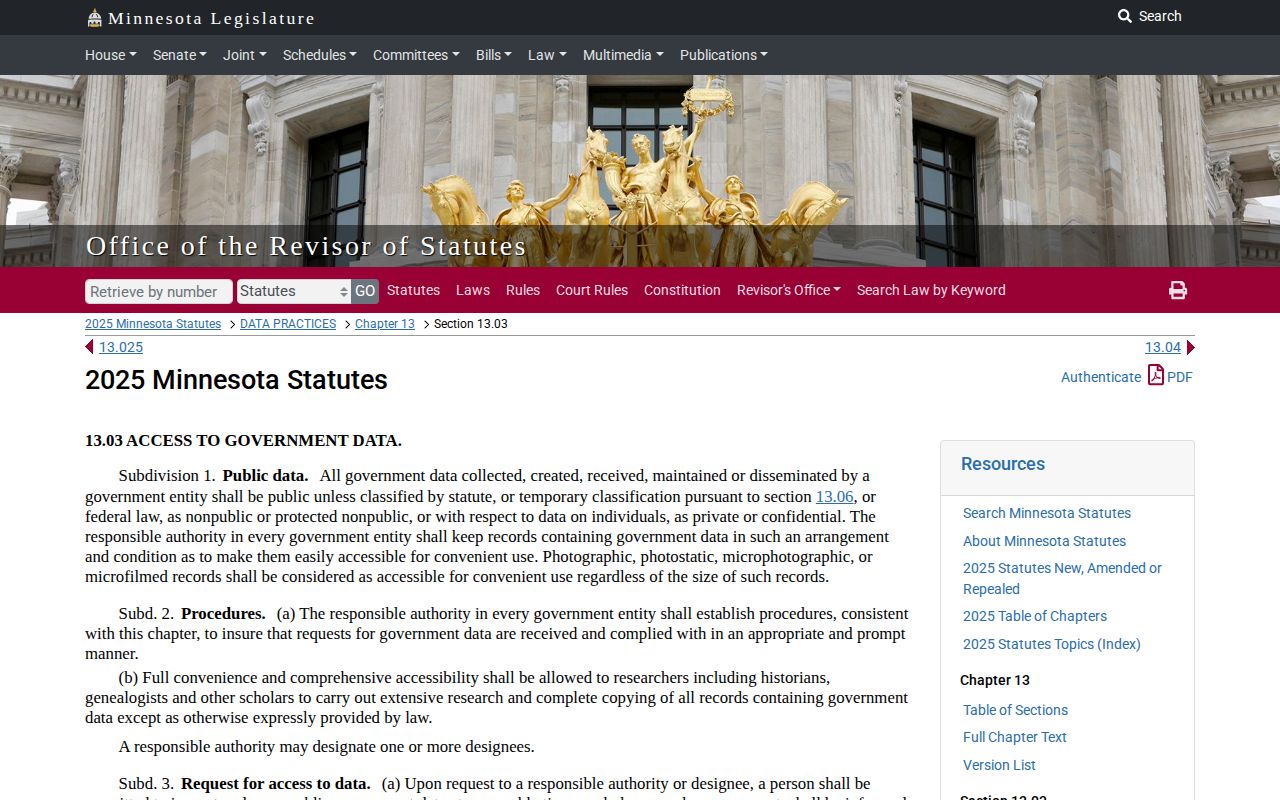
The statute source helps frame a precise request, while the Chippewa County Sheriff remains the office that can identify the custody fields it actually maintains.
Website visibility and government retention are separate questions. The lack of a public archive does not mean the booking and release data were destroyed. Ask for existing records and, when needed, the retention schedule that applies to them. If a field is not public, the response may still produce other separable public fields. The aim is a dated, source-agency account of the movement, not an assumption based on what is missing online.
Reconcile Chippewa Release Destinations
Classify each three-day exit before counting it as a community release. A bond or court-order event may return the person to the community. “Time served” can end the jail portion while probation or another case remains. A detainer may cause staff to transfer the person without a public walk-out. “Discharge” can refer to the later end of an agency’s jurisdiction, so it should not be treated as a synonym for the jail door opening.
For a Minnesota prison commitment, use the DOC Public Viewer and read Current Status. A person outside prison but under community supervision remains within DOC jurisdiction. A finally discharged former state prisoner may no longer appear, so DOC Records Management and the court file become more important. BOP can retain a released date for many federal prisoners. ICE’s locator is custody-focused, and USMS lacks a broad historical public release search.
The Chippewa County Sheriff page links the official county roster and VINE. Use that gateway to avoid third-party “recent booking” products that may mix arrests, current custody, and unsupported release claims.
Match identities across systems with stable identifiers when available. The county booking number and MNI belong to the local custody record. Minnesota DOC uses an MNDOC offender ID, while MCRO relies on the court file number. Age or name alone can point to the wrong person. Carry the correct booking and case references into each follow-up, and use no more personal information than needed to resolve the record.
Confirm Chippewa County Releases
Finish the three-day review by matching the booking number, out timestamp, movement code, and receiving authority. Then compare the court register for the order or disposition that led to the event. A VINE message can support timing, but the county custody record should resolve the exact Chippewa County exit. When data conflicts, ask the office that created each record to explain its own field.
For activity limited to today, the 24-Hour Release List focuses on same-day VINE registration and an exact-time request. When the goal is a broader search for one named person, use the Chippewa County released-inmate search on the home page to move among jail, court, state, and federal sources.