
Chippewa County Projected Release Meaning
A projected release date is an expected custody transition based on the sentence, credits, and rules known when the calculation is made. It is not the same as the actual time a jail or prison opens the door or transfers the person. Minnesota DOC uses the official label Anticipated Release Date. That date must also be kept separate from the DOC Expiration Date, which marks the legal end of the sentence or jurisdiction shown by the record.
A person can leave a prison on the anticipated date and remain under supervised release in the community. Supervised release is the community part of an executed prison sentence. Final discharge may occur much later. At Chippewa County Jail, the current roster has no projected-release field. A local date must be confirmed from the jail commitment, the sentencing order, and the people responsible for the jail calculation.
Choose Chippewa County Release Records
The right source depends on the custodian. A recent local booking points first to Chippewa County Jail. A person committed to the commissioner of corrections belongs in the Minnesota DOC public search even when the criminal case began in Chippewa County. A federal sentence belongs in the BOP locator, while federal pretrial custody may require a court or U.S. Marshals inquiry.
| Custody situation | Best date source | Key limit |
|---|---|---|
| Pretrial at Chippewa County Jail | Jail, court file, and bond or release order | No fixed date may exist. |
| Local jail sentence | Commitment, court order, and jail staff | The live roster shows no projected date. |
| Minnesota prison sentence | DOC Anticipated Release Date and sentence record | The date can change and is not Expiration Date. |
| Federal prison sentence | BOP Inmate Locator and federal record | County and Minnesota DOC tools do not control it. |
| Transfer or detainer | Movement record and receiving agency | Leaving one roster may not mean community release. |
A pretrial detainee has not reached a sentence calculation. Bond may be posted, a court may modify conditions, a case may be resolved, or another hold may prevent release. Court documents can state authority, but the jail’s out time remains the best proof of the actual physical movement.
Note: A court order can authorize release without establishing the exact time every hold was cleared and the person left custody.
Find Chippewa County Anticipated Release
For a state prisoner, open the official Minnesota DOC public viewer. Search by first and last name or the complete six-digit MNDOC Offender ID. Name searching is prefix-based and includes DOC name history. That can produce several possible matches, so use the ID, birth date, AKA information, offense, and court file number to identify the correct person.
- Search the DOC public viewer by name or complete MNDOC ID.
- Match the person using the least data needed.
- Open the detail record and read Current Status.
- Record Anticipated Release Date and Expiration Date separately.
- Match the court file and inspect the sentencing documents.
- Check Current Status again after the anticipated day.
The detail record can also show Sentence Date, caseworker and telephone, highest ranked offense, court file number, and court or BCA links. A newly sentenced person may take several business days to appear. The locator covers adults still under DOC jurisdiction, whether incarcerated or released under supervision. A finally discharged person can fall outside that stated scope.
The distinction is visible in a privacy-safe Minnesota DOC offender detail example.
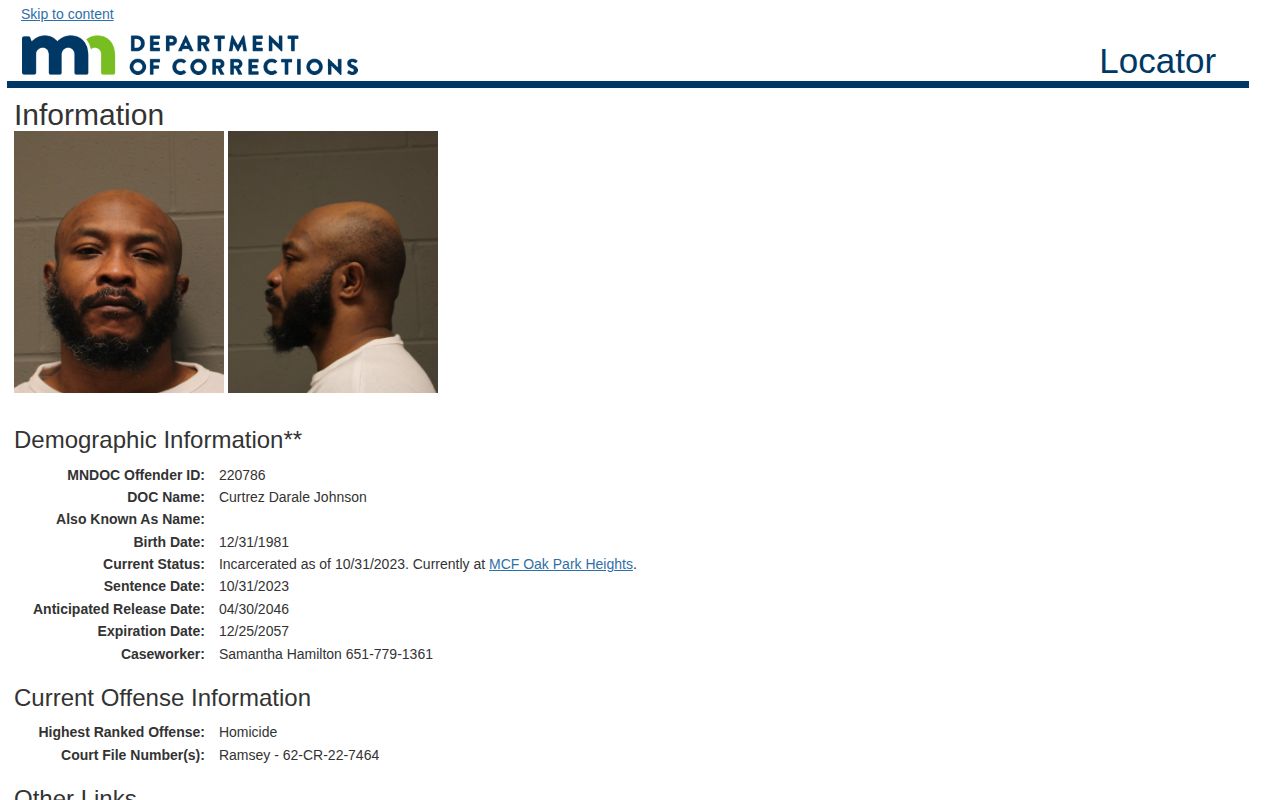
The example places Anticipated Release Date beside Expiration Date, reinforcing that prison exit and final sentence end are distinct events.
Chippewa County Jail Release Calculations
Chippewa County’s live in-custody list shows current booking information, charges, and bail or bond data, but it does not publish a projected-release date. For a person serving a local sentence, begin with the court file and commitment. Confirm the sentence start, jail credit, whether terms run together or one after another, and any later court amendment. Then ask jail staff to confirm the date produced by the official calculation.
Jail credit accounts for qualifying custody time applied to a sentence. Consecutive terms run in sequence rather than at the same time. A detainer is a request or authority that can keep a person held or cause a transfer after the local term. Each can change the practical answer to when someone will leave Chippewa County custody.
Contact the Chippewa County Sheriff at 320-269-2121 for the jail record. For the court order, use Minnesota Court Records Online or Chippewa County District Court. Ask for the out date and movement reason after the expected date passes. A person who leaves the local roster for DOC, federal, immigration, or another county custody has transferred rather than returned to the community.
- Jail credit
- Qualifying time already spent in custody that is applied to the sentence.
- Consecutive sentence
- A term that begins after another term rather than running with it.
- Detainer
- An authority or request that may lead to continued custody or transfer.
- Discharge
- The end of an agency’s legal jurisdiction, not merely prison exit.
Minnesota Release Credit Rules
Minnesota is not an “85 percent” state in the common federal sense. For covered felony offenses on or after August 1, 1993, Minnesota Statutes § 244.05 ordinarily assigns one-third of the executed sentence to supervised release. This is often described as two-thirds in prison and one-third in the community, subject to the statute and other applicable rules. Disciplinary confinement can delay the transition from prison.
The Minnesota Rehabilitation and Reinvestment Act adds earned incentive release credit for eligible people who complete objectives in an individualized rehabilitation plan. Under § 244.44, the earned reduction is capped at 17 percent of the total executed sentence and cannot reduce imprisonment below one-half. It does not lengthen the supervised-release term. Credits can be revoked for institutional misconduct.
Eligibility is not universal. Life sentences, specified old indeterminate sentences, and people governed by older good-time systems are excluded under § 244.45. Offense-specific conditional release, consecutive terms, sentence amendments, and other statutes may also apply. The public Anticipated Release Date is therefore safer than subtracting a broad percentage from the pronounced sentence.
The current Minnesota corrections and release chapter collects the sentencing, supervised-release, and earned-incentive provisions.
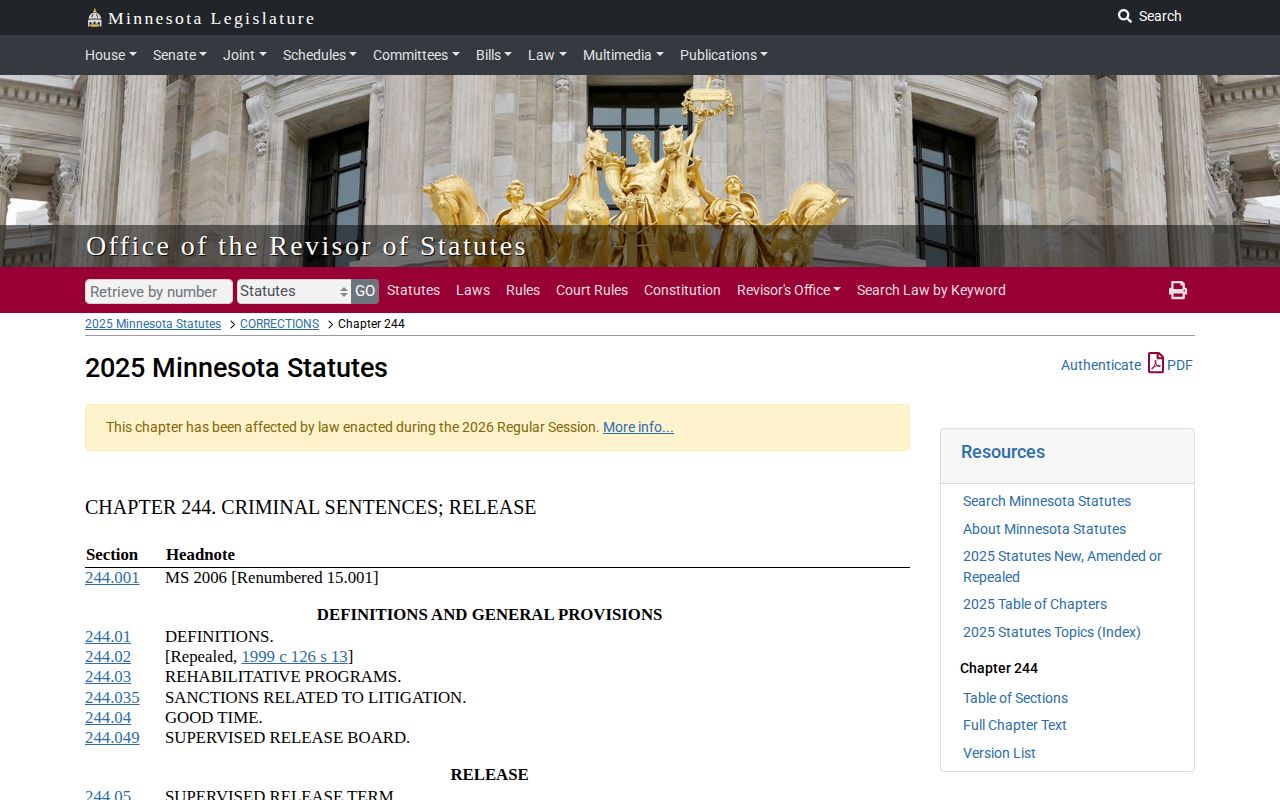
The chapter view supplies the legal context needed before applying any single release-credit section to a Chippewa County case.
Why Chippewa County Release Dates Change
An anticipated date is recalculated when a fact or governing rule changes. A later date is not automatically an error, and an earlier date is not proof of immediate release. Compare the current DOC record, sentencing documents, and any movement record before drawing a conclusion.
| Factor | Possible effect on the expected date |
|---|---|
| Institutional discipline | Disciplinary confinement or revoked credit can delay prison release. |
| Earned incentive credit | Approved credit can reduce eligible imprisonment within statutory limits. |
| Jail credit | Corrected qualifying custody time can alter the calculation. |
| Sentence amendment | A later court order can change the term or how terms run. |
| Consecutive terms | Terms served in sequence extend the combined calculation. |
| Detainer or hold | The person may leave one custodian but remain held by another. |
| Conditional-release law | An offense-specific term can affect custody or supervision timing. |
Parole should not be used as a broad label for every Minnesota prison release. Modern determinate sentences usually involve supervised release. Parole remains relevant to limited life, older indeterminate, and certain early-release classes. Probation is imposed by a court and does not itself prove that a person left prison.
Note: Record the date on which an anticipated release was viewed, since the DOC public field can be updated after a recalculation.
When Minnesota Release Dates Shift
Minnesota’s weekend and holiday adjustment turns on the offense date. Under § 244.05, subdivision 1a, a qualifying scheduled release for an offense committed before August 1, 1992 moves from Friday, Saturday, Sunday, or a holiday to the preceding qualifying day. For an offense committed on or after that date, the same type of scheduled date moves forward to the next qualifying day.
The direction therefore cannot be guessed from the weekday alone. First identify the offense date and the rule that governs the sentence. Then read the current DOC Anticipated Release Date rather than manually shifting a calendar date. Older cases may also fall under older good-time or indeterminate-sentence rules, which makes current general formulas a poor substitute for the record.
This rule concerns the scheduled release adjustment. It does not erase a detainer, resolve another sentence, or establish the precise physical-out time. Check Current Status after the adjusted date and ask the custodian for the actual movement event.
Chippewa County Release Versus Expiration
Minnesota DOC’s Anticipated Release Date and Expiration Date answer different questions. The anticipated date estimates when prison confinement ends or changes to community supervision. The expiration date reflects when the sentence or DOC jurisdiction shown in the record ends. Someone may be outside the prison and still have a DOC Current Status that reflects supervised release.
The legal structure for that transition appears in the Minnesota supervised-release statute.
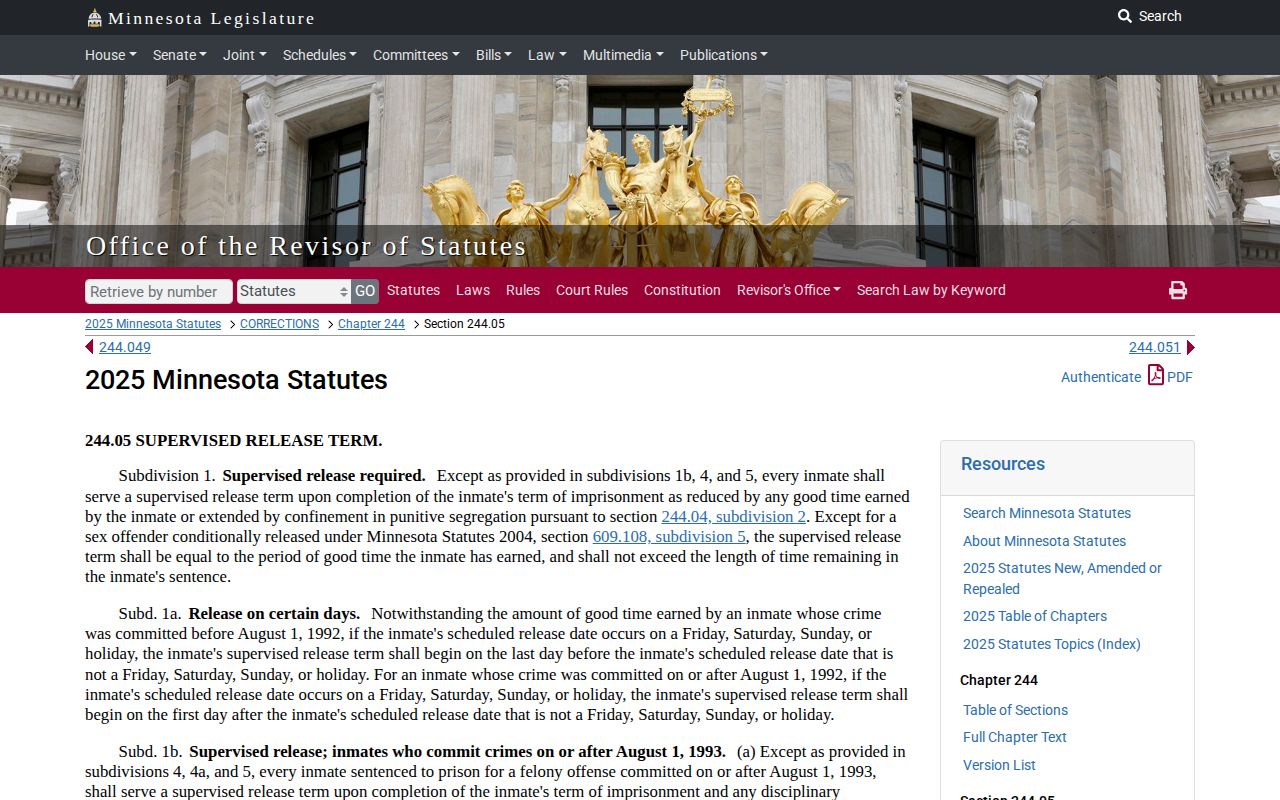
The statute helps explain why physical release, active supervision, abatement, and final discharge can occur at different points in the same sentence.
To confirm an actual state release, match the MNDOC ID and court file, save the anticipated and expiration dates as separate fields, and check Current Status after the expected day. For a difficult calculation, contact the listed caseworker or Minnesota DOC Records Management at CO-Records.DOC@state.mn.us. For a local sentence, use the Chippewa County commitment and jail movement record instead.
Verify Chippewa County Release Dates
A pending date becomes a confirmed event only after the responsible agency records the movement. For a person at Chippewa County Jail, Minnesota VINE can send a county custody-change alert if registration occurs while the record is active. For a state prisoner, Minnesota HAVEN is the separate DOC notification service. The Chippewa County VINELink check explains that county and prison split.
After the expected day, read the event type. Release, transfer, and final discharge do not mean the same thing. If DOC Current Status shows community supervision, the person has left the prison setting while remaining under DOC jurisdiction. If the county record names another authority, follow that receiving custodian. When records conflict, prefer the originating agency’s timestamp for its own custody and request a correction for a clear identity or movement-code error.
No result is also limited evidence. A county-only sentence may never appear in the DOC locator, and a finally discharged person can fall outside its stated scope. A missing current jail row can reflect release, transfer, or correction. The source record and court file are needed to establish what happened.