
Chippewa County Parole and Probation
Parole and probation are not two names for the same status. In Chippewa County, probation is imposed by a court. A judge may stay all or part of a sentence while requiring the person to follow stated terms in the community. A short jail stay may occur before probation begins, but probation alone does not establish a release from state prison. The court case is the best source for the order, sentence terms, later changes, and any discharge from probation.
Supervised release is usually the community part of an executed Minnesota prison sentence. The person has left a Minnesota Department of Corrections institution but has not necessarily reached the sentence expiration date. Parole now applies to narrow groups, including some life sentences, old indeterminate sentences, and certain early-release reviews for offenses committed by people under 18. Final discharge ends the sentence or agency jurisdiction. Abatement may stop active supervision contacts while the legal expiration date remains later.
| Status | Who imposes or controls it | Best verification source |
|---|---|---|
| Probation | Chippewa County District Court, with local supervision | MCRO case record and 6W Community Corrections |
| Supervised release | Minnesota prison sentence and release law | Minnesota DOC Current Status and public records |
| Parole | Supervised Release Board for limited eligible cases | Board schedule, approved minutes, and DOC record |
| Final discharge | Court or corrections authority, based on the sentence | Discharge entry, expiration date, or public order |
Verify Chippewa County Release Supervision
No single public person-name search covers every form of Chippewa County supervision. The Minnesota DOC public viewer is the first official check when a state-prison sentence is possible. Its Current Status can separate prison custody from community status, while sentence and date fields help identify the correct record. For a county probation case, search the official Minnesota Court Records Online system and contact 6W Community Corrections when the public case file does not answer the supervision question.
Use a dated, identity-matched process. A name match without the same birth details, court file, DOC number, or sentence can point to the wrong person. Public adult court-services data may include whether someone is a probationer or parolee, the supervising unit, supervision dates, conditions, and the legal basis for a status change. Some safety, health, investigative, and corrections data remain restricted.
- Identify whether the sentence came from Chippewa County District Court or involved commitment to Minnesota DOC.
- For a prison case, search the Minnesota DOC public viewer and match the DOC ID, name, sentence, and Current Status.
- For probation, search Minnesota Court Records Online for the case, sentence, probation, violation, revocation, and discharge entries.
- Contact 6W Community Corrections for the public information it may lawfully confirm.
- Request existing public supervision data when the online records omit the start date, end date, supervising unit, or reason for a change.
Chippewa County Probation Office
Chippewa County belongs to 6W Community Corrections, a joint-powers agency serving Chippewa, Lac qui Parle, Swift, and Yellow Medicine Counties. This regional structure matters. A local probation or supervised-release question may belong to 6W rather than a general Minnesota DOC field office. Justice agencies use the S³ supervision system, but it has no public person-name search. The central office can route a focused inquiry and explain what adult court-services data may be released.
The office is a verification point, not an open roster. Give the person’s full name, the Chippewa County court file if known, and the type of public fact sought. Ask for the supervising unit, supervision start and end dates, or public discharge information rather than private case notes. Call first to confirm access and office availability.
6W Community Corrections
129 Nichols Avenue
P.O. Box 511
Montevideo, MN 56265
Phone: 320-269-6513
Coverage: Chippewa, Lac qui Parle, Swift, and Yellow Medicine Counties
The official 6W Community Corrections page identifies the local agency and Montevideo contact. The screenshot below shows the county source used to route local supervision questions.
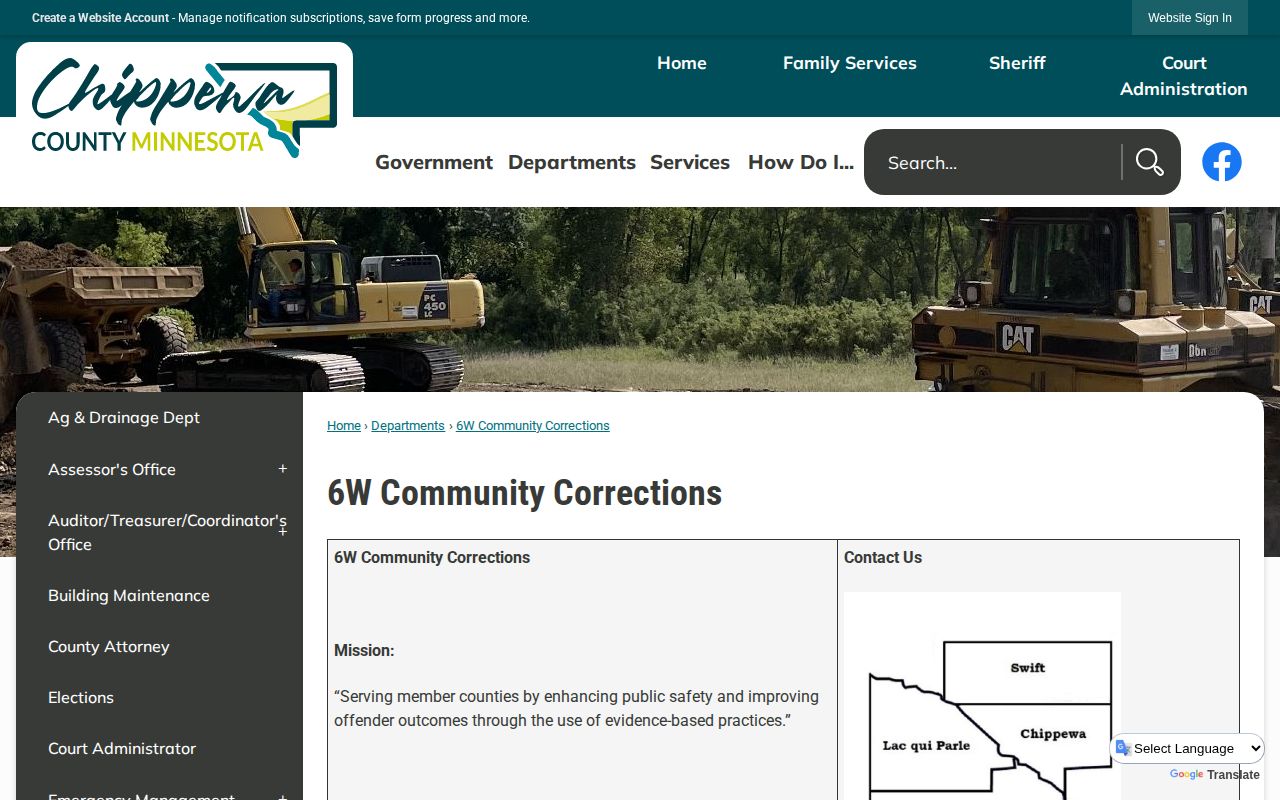
That county page provides a real local starting point, while the court and DOC records establish the sentence and custody status.
Chippewa County Supervision Record Fields
Minnesota Statutes section 13.84 defines public adult court-services data. The public portion can include whether a person is a parolee, probationer, or diversion participant and the stated location. It can also include the offense, the duration of supervision, the start and end dates, the supervising unit or person, and the legal basis, date, time, and place of a supervision change.
Public information may also cover supervision conditions and the extent of compliance, plus public arrest, detention, revocation orders, and their reasons. That does not open the whole supervision file. Corrections, health, safety, victim, and active investigative information can be private or protected. When an office withholds part of a record, ask for the public fields that can be separated and the legal classification used for the withheld material.
- Supervised release
- The community portion of many executed Minnesota prison sentences.
- Probation
- A court-ordered community status, often tied to a stayed or limited custodial sentence.
- Parole
- Conditional release used for limited sentence classes reviewed under Minnesota law.
- Revocation
- An official action that can return a person to custody after a violation finding.
- Discharge
- The end of the sentence or supervising authority, not merely release from a building.
- Absconder
- A person alleged to have stopped required contact or evaded supervision.
Chippewa County Absconder Status
A missed appointment, alleged violation, active warrant, and fugitive listing each mean something different. A court record may show a probation-violation filing or warrant. Minnesota DOC’s active-fugitives channel may list a person who left prison for community supervision and is now alleged to be avoiding authorities. That listing is not a new conviction. It also does not prove the person is confined at the Chippewa County Jail or any named facility.
Check the Minnesota DOC active-fugitives gateway for a state supervision case. The published 24-hour tip line is 651-603-0026. A county warrant should be checked through the official sheriff source, then read with the court register. Do not treat a warrant as proof of current custody. If a person is arrested on a supervision matter, the new jail record and the later revocation order answer separate questions.
Note: An absconder listing reports an allegation and status, while a court or release record supplies the later action and date.
Chippewa County Parole Hearing Records
Minnesota’s Supervised Release Board took effect July 1, 2024 under section 244.049. It is not a routine parole board for every person leaving prison. Its scope includes life sentences with release possibility, old indeterminate sentences for crimes on or before April 30, 1980, and qualifying early-release review for offenses committed under age 18. Most ordinary determinate releases follow statutes and sentence calculations without a conventional parole hearing.
The Supervised Release Board overview explains that narrow role. Its calendar, agendas, minutes, and recordings page is the official hearing source. Schedules are updated, but no fixed monthly cadence should be assumed. Prior page materials remain for a limited period, while approved minutes are the practical decisions source because no separate person-name decision database was found.
Minutes can show a denial with a later review date and directives, revocation, conditional parole through staged work release, or a grant within a defined period. Eligibility and minimum service are sentence-specific. The conviction law, offense date, sentence, and controlling statutory version must all be read before drawing a conclusion.
Chippewa County Supervision Changes
Conditions may govern reporting, travel, treatment, contact, residence, or other conduct stated in the public order. A violation allegation can lead to a hearing, modified terms, continued supervision, revocation, or custody. The legal result should come from the court or corrections record, not from rumor or the fact that a name vanished from one list.
Notifications also depend on the custodian. Minnesota VINE connects to county jails and detention facilities, including the Chippewa County Jail feed. It does not cover Minnesota state prisons. Minnesota DOC uses Minnesota HAVEN for prison custody notifications. Neither system is a complete public supervision history, and a custody-status alert should be read by its event type. Release, transfer, and return to custody are not interchangeable.
A prison release date and the end of supervision may be far apart. The DOC detail can show Current Status and an Expiration Date, while a records request may supply the actual release event and the start or end of supervision. The broader Chippewa County released inmate search and records path explains how the county release record, court file, and state record fit together.
Chippewa County Release Support
6W Community Corrections is the distinctive local link between a regional supervision system and Chippewa County. It provides probation and supervised-release functions and programming across four western Minnesota counties. Its Montevideo central office offers a concrete place to route a lawful question, but the county page does not publish a person-name lookup. That absence is important because a failed web search does not establish that supervision ended.
Chippewa County Restorative Justice is a separate local program. Its official page includes Circle Sentencing information, but participation is not a release certificate, a supervision roster, or proof of a case result. Program contacts can help with service navigation. Only the court and supervising authority can establish the actual terms and discharge.
To close the search, preserve the date of each source checked. Compare the court sentence, DOC Current Status when relevant, the public supervision dates, and the most recent lawful order. If the dates conflict, request the existing public status-change record rather than assuming the newest website entry tells the whole story.